
Dr Michael Galvez explains how the technique uses existing pterygium tissue for defect coverage and where it fits among established reconstructive options.
Pediatric finger flexion contractures, particularly those resulting from burns, can present reconstructive challenges when extensive scarring limits joint extension. While established techniques such as Z-plasty and skin grafting remain important treatment options, broad volar contractures may require alternative approaches to achieve adequate release and durable tissue coverage. These challenges can become more pronounced as children grow, increasing the risk of recurrent deformity.
A recent study published in Journal of Hand Surgery Global Online examines the double opposing stiletto (DOS) flap, a local tissue rearrangement technique that uses existing pterygium tissue to release contractures and reconstruct the resulting defect. The technique was also presented at the 2026 Plastic Surgery Research Council (PSRC) meeting.
The retrospective case series included eight pediatric patients who underwent 12 DOS flap procedures, primarily for burn-related contractures. Average joint angles improved from 50 degrees preoperatively to 9.5 degrees at follow-up. All flaps remained viable, and all patients demonstrated improved ability to straighten their fingers and place their hands flat.
Plastic Surgery Practice spoke with study co-author Michael Galvez, MD, who is board certified in plastic and reconstructive surgery and director of the Pediatric Hand and Upper Extremity Program at Valley Children’s Specialty Medical Group, about the technique’s surgical rationale, patient selection, clinical outcomes, and potential role alongside established reconstructive approaches.
Plastic Surgery Practice: What clinical problem prompted you and your colleagues to explore the DOS flap for pediatric finger flexion contractures?
Michael Galvez, MD: One of the challenges we frequently encounter in pediatric hand surgery is the child with a finger flexion contracture that has progressed beyond a simple linear scar. Many of these patients, particularly after burns, develop a broad volar scar band with a pterygium, or web of excess tissue, extending across the joint. Traditional techniques such as a Z-plasty work well for thin linear contractures, but they are often insufficient when the contracted tissue is wide and spans the entire flexion crease. In these children, growth can worsen the deformity over time, making it increasingly difficult for them to straighten the finger or place the hand flat. The DOS flap evolved from the need to use the tissue already available in the pterygium to release the contracture while providing durable local tissue coverage without relying solely on skin grafting.
PSP: For surgeons who are unfamiliar with the technique, can you walk us through the DOS flap and the surgical principles behind it?
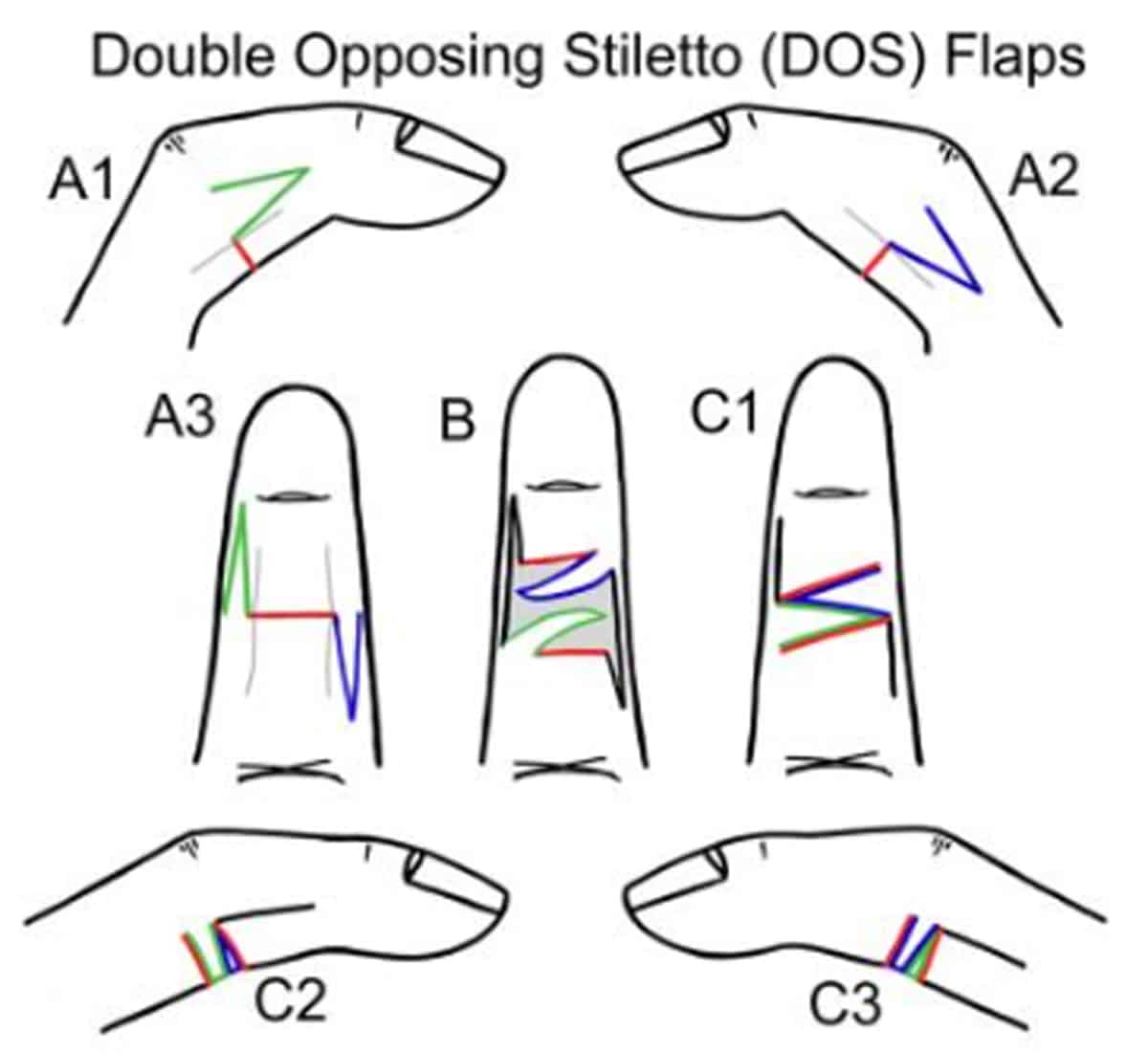
Galvez: The Double Opposing Stiletto (DOS) flap is a local tissue rearrangement technique designed for pediatric finger flexion contractures that have available pterygium tissue. The key principle is to first completely release the transverse volar contracture and then recruit tissue from both sides of the pterygium to reconstruct the resulting defect.
A central transverse release is performed across the contracted volar scar. Two opposing stiletto-shaped flaps are then designed on the radial and ulnar aspects of the finger using the redundant pterygium tissue. After elevation, the distal flap is transposed proximally and the proximal flap is transposed distally, allowing both flaps to meet in the center and cover the volar defect. Donor sites are closed primarily whenever possible.
The concept is illustrated in the DOS flap design schematic.
PSP: Most patients in the series had burn-related contractures. What made these cases good candidates for the DOS flap, and what factors do you consider when selecting patients for this approach?
Galvez: Burn-related contractures were ideal candidates because many of these children developed a characteristic broad volar scar with a pterygium spanning the involved joint. Importantly, they often retained tissue redundancy along the radial and ulnar sides of the pterygium that could be recruited into flaps.
When selecting patients, I look for several factors: the presence of a wide transverse volar contracture, adequate pterygium tissue for flap design, intact tissue quality along the planned flap path and confidence that the family can comply with postoperative casting, splinting and hand therapy. I also evaluate whether there is scarring over the flap design area or a history of digital artery injury, as these can increase the risk of ischemic complications.
PSP: The technique relies on available pterygium tissue. What makes that tissue useful from a reconstructive standpoint, and how does it influence your operative planning?
Galvez: The pterygium is often viewed as part of the deformity, but reconstructively, it represents an opportunity. It contains local, well-matched skin and subcutaneous tissue that is available from the finger. Rather than excising that tissue, we divide the tissue and mobilize the local flaps for coverage.
In operative planning, we carefully assess how much radial and ulnar tissue is available and whether donor sites can be closed primarily after flap transposition. The amount and location of available pterygium tissue largely determine flap design, size and orientation. Every DOS flap is individualized to the specific contracture pattern and the tissue available around the affected joint.
PSP: What advantages does the DOS flap offer compared with other techniques used to release pediatric finger contractures?
Galvez: The biggest advantage is that it uses local tissue to reconstruct the released contracture. Local flap tissue generally heals more reliably than skin grafts and may have less tendency toward recurrent scar contracture. This is particularly important in growing children, where recurrence can become magnified over time as the skeleton continues to lengthen.
The DOS flap also lets both the defect and donor sites be closed primarily in many cases, avoids creating additional distant donor-site morbidity and preserves color and texture match. In our series, all flaps survived, there were no neurovascular complications and all patients experienced improved ability to straighten the finger and lay the hand flat. Average joint angles improved from 50 degrees preoperatively to 9.5 degrees at follow-up.
PSP: Where does the DOS flap fit within the broader range of reconstructive options for these patients, and in what situations would you choose another local flap, skin graft, or alternative reconstruction instead?
Galvez: I view the DOS flap as a valuable addition to the reconstructive armamentarium rather than a replacement for established techniques. It is best suited for contractures with a broad transverse volar component and sufficient pterygium tissue.
For thinner contractures, a standard Z-plasty may be more appropriate. When multiple joints are involved or local tissue is inadequate, full-thickness skin grafting may be necessary. In our series, several fingers required adjunctive skin grafting or additional Z plasty for adjacent joints. More severe deformities, extensive scarring or complex joint pathology may require alternative approaches.
PSP: In addition to the improvements in joint angles reported in the study, what functional outcomes are most important when evaluating success in these young patients?
Galvez: Although joint angle measurements provide objective data, some of the most meaningful outcomes are practical and functional. One of the simplest measures is whether a child can place the hand flat on a table. Prior to surgery, none of the children in our series could do this; afterward, every patient demonstrated improvement.
Beyond that, we look at ease of hand use, grasp, object manipulation, participation in school and play activities, and overall appearance. For children and families, appearance matters, as well. A straighter finger that looks more normal can improve confidence and social interactions while also enhancing function.
PSP: Based on your early experience, how do you see the role of the DOS flap evolving, and what additional research is needed to better define its long-term outcomes?
Galvez: Our initial experience suggests that the DOS flap is a reliable and versatile option for selected pediatric finger contractures and can help reduce dependence on skin grafting in appropriately chosen patients. The technique worked across both burn-related contractures and congenital conditions, such as camptodactyly.
Moving forward, the most important question is durability over time as the child grows from young child to adolescent and adult. Children continue to grow for many years after reconstruction and long-term follow-up will be critical to determine recurrence rates and functional outcomes over time. Future studies with larger patient populations, longer follow-up, comparison to other techniques and standardized patient-reported outcome measures will help define where the DOS flap fits among other reconstructive options. PSP
Image courtesy of Dr Michael Galvez.

