
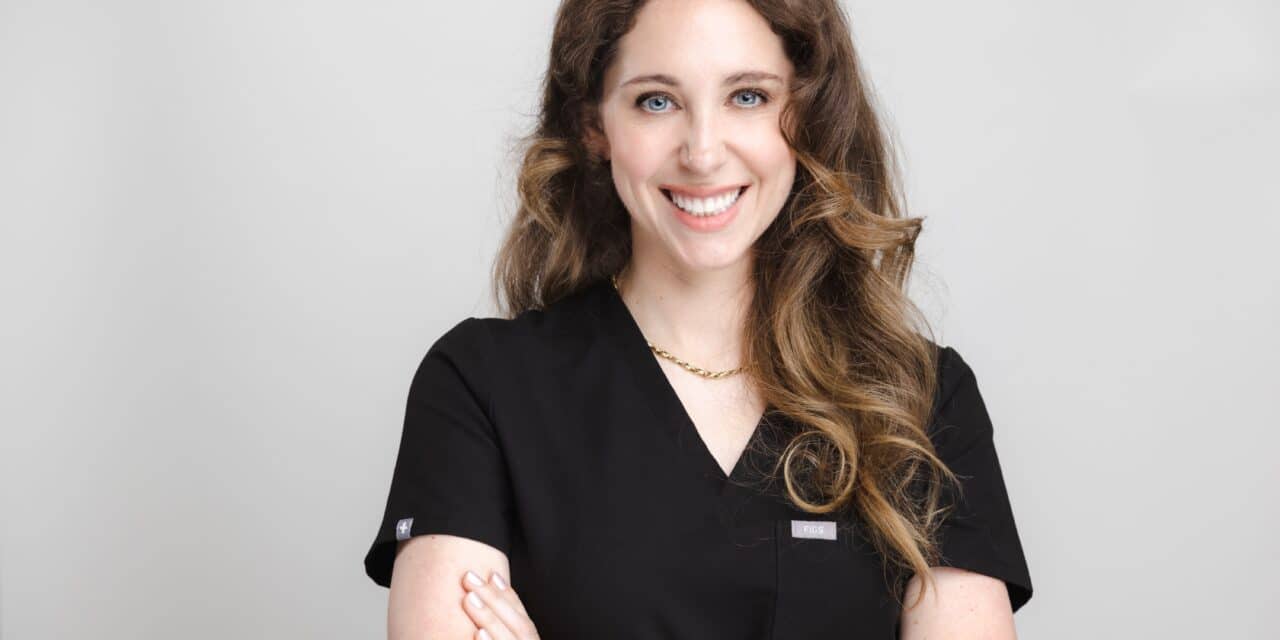
One year after opening her Raleigh practice, Dr Heather Levites has established something the field has few examples of: a woman-owned, surgery-capable private practice, staffed entirely by women, in one of the country’s most competitive healthcare markets.
By Alison Werner
When Heather Levites, MD, opened LevityLifts in Raleigh, NC, last August, she was two years out of residency and under 40. She was also stepping into a category the U.S. plastic surgery landscape has very few examples of: a woman who owns her own surgery-capable practice. Of the roughly 7,461 board-certified plastic surgeons actively practicing in the United States, only about 17% are women, according to a 2023 analysis published in Plastic and Reconstructive Surgery – Global Open. Fewer still own a practice with surgical capabilities and lead that practice with an entirely female clinical and administrative team.
The milestone earned Levites Surgeon of the Year honors from the Triangle Business Journal and a clinical faculty appointment at Duke, where she completed her plastic surgery residency. For colleagues weighing a similar move, however, the more instructive account is how she reached this point, and what she would counsel a peer considering the same path.
From Off-Broadway to MIT to the OR
Levites grew up in New York City, studying to be a dancer and fine artist, and briefly performed in an off-off-Broadway production before deciding the work’s repetition wasn’t for her. She studied finance and economics at MIT, spent several years as a financial analyst on Wall Street, and then pivoted through a post-baccalaureate program at Columbia and medical school at Stony Brook before matching at Duke for plastic surgery training.
“I have a little bit of right and left brain, which I think is really [ideal] for plastic surgery,” she says. “It really is the perfect amalgamation of both my interests — math and science, as well as being creative and artistic. And then I also love talking to people.”
After Duke, Levites completed an aesthetic surgery fellowship in Charlotte under Drs Hunstad, Kortesis and Bharti, and then joined their group, H/K/B Cosmetic Surgery, as an employed surgeon covering a Chapel Hill office. The arrangement, she says, allowed her to concentrate on patient care and board certification without the operational demands of ownership. Geography ultimately forced the next decision: Chapel Hill sat 45 minutes to an hour from where she and her husband were building their life. “I realized, I want to be where our life is,” she says. “So, I needed to start my own practice.”
Building an OR From Scratch
Immediately, Levites realized that opening her own practice in Raleigh would require an operational commitment her previous employer had shielded her from: a surgical facility of her own. The Triangle—the North Carolina region encompassing Raleigh, Durham and Chapel Hill, and anchored by Duke, UNC and NC State—offers little in the way of affordable surgery-center block time for community surgeons, according to Levites. By contrast, in Charlotte, where she trained, area hospitals were, in her description, “much more set up for cosmetic cases,” giving private-practice surgeons a workable off-ramp for procedures they could not accommodate in office. Raleigh, she says, offered no comparable option. If she intended to operate, she would need to build her own OR.
Levites elected to retrofit an existing medical space rather than build from the ground up, a decision she questions in hindsight. The central obstacle was identifying an architect with experience designing an office-based surgery suite, which is regulated differently than an ambulatory surgery center. Because Levites does not accept insurance and her patients are not intubated—she uses a supplemental oxygen tank connected to her anesthesia machine in place of piped medical gases—she was able to build to a leaner standard, saving what she estimates at six figures or more. Permitting nonetheless consumed nearly six months, and errors emerged once construction was underway. “It was really nine months before we actually got going with the buildout,” she says. “In retrospect, buying land and building something from the ground up probably would have been easier.”
The completed suite houses two operating tables. The second currently accommodates minor procedures—laser treatments, upper blepharoplasties and cases performed under local—but was designed to support a second surgeon, a hire Levites expects to begin recruiting for within six months, with a focus on breast and body. Anesthesia is provided by a contracted group of three to four CRNAs familiar with her preferences, an arrangement she says costs no more than a single full-time hire while ensuring coverage for vacation, illness and after-hours emergencies.
A Female-Friendly Practice, Deliberately Designed
Roughly 90% of Levites’ patients are women, and the office was designed with them in mind. The floor plan forms a circle around three interior exam rooms, a photo room, a private post-op waiting room for family, and a break room she deliberately oversized. “A lot of the practices I toured minimized that because it’s not revenue generating,” she says. “But for me, team meetings and idea generating in the long run is very valuable.” The main patient waiting room, by contrast, is intentionally small, a consequence, she says, of running on time.
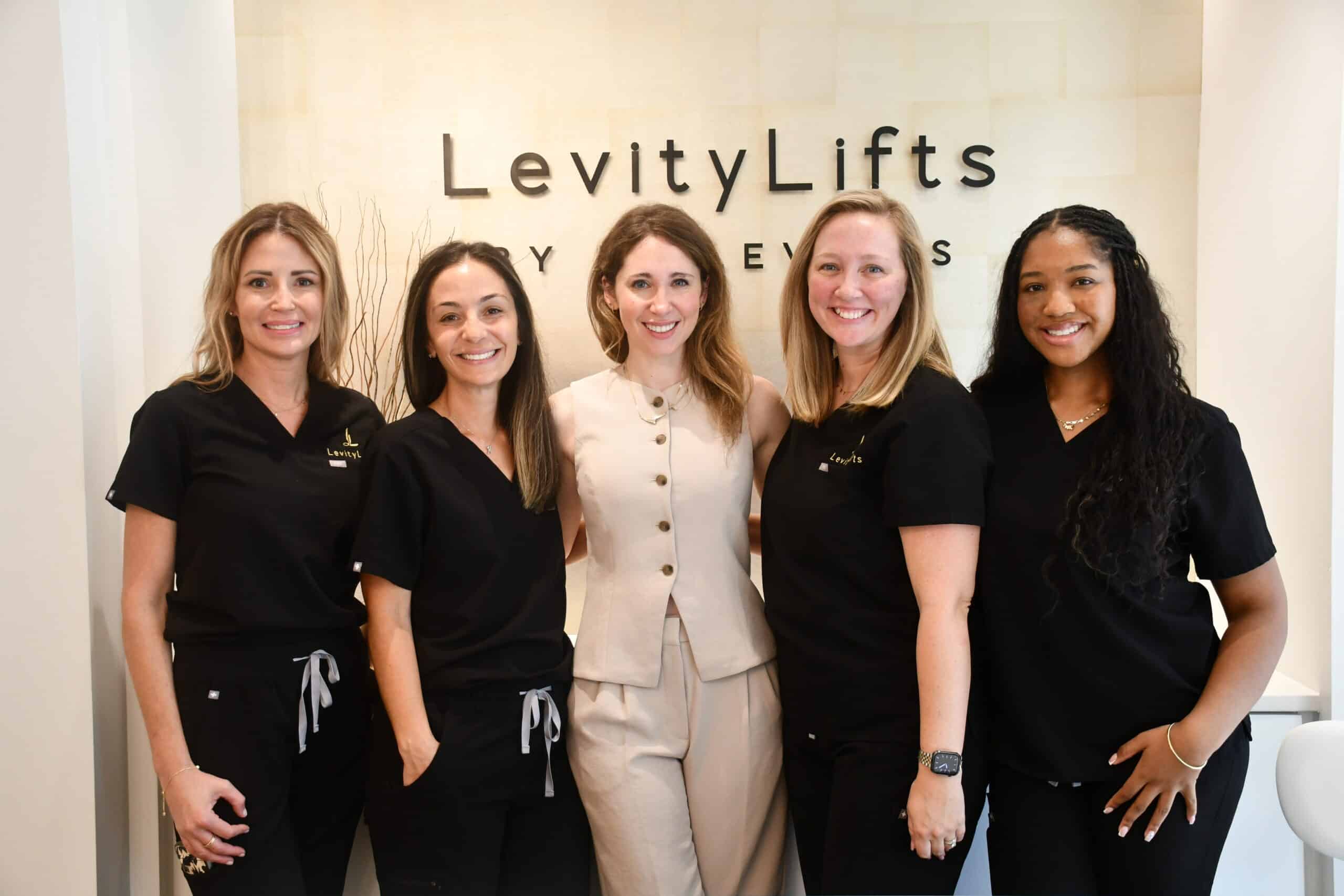
The team numbers five, all women: a nurse practitioner overseeing lasers and clinical operations; a nurse injector for neurotoxins, fillers and microneedling; an LPN managing pre-op clearances; a front-desk manager; and a part-time social media manager. The surgical first assist doubles as patient care coordinator, moving cases through the front of house on non-surgical days. Her familiarity with the practice’s equipment and supply needs also makes her the anchor for ordering and OR stocking. Every clinical role is cross-trained. There is no office manager; Levites, drawing on her finance background, runs payroll herself—a task she says takes 15 minutes every other week—and distributes the remainder of the operational work among staff who, she notes, appear to prefer reporting directly to the surgeon.
The all-female staffing model is as philosophical as it is practical. “My hope is that plastic surgery goes the way of OB/GYN,” she says. “Whatever health, mental health, physical health—it’s a women’s health issue, and female patients just feel more comfortable expressing those concerns with another woman.” The approach has also attracted patients whose religious observance leads them to prefer female providers.
Finding a Niche in a Saturated Market
As Levites explains, Duke, UNC and NC State continually seed the region with well-trained physicians who often remain in local practice, and the field is crowded as a result. Levites, however, regards density as an asset. “If you’re going to move into a market that has more surgeons, you’re just forced to create a niche more quickly,” she says, likening the dynamic to a fast-food corridor in which competitors draw traffic to one another rather than away.
Her niche emerged naturally: 60% to 75% of her cases are now facial, including facelifts, necks, eyelids, brow lifts, rhinoplasty and ablative laser work. The balance skews toward massive-weight-loss body contouring and revision cases across breast, liposuction and abdominoplasty. Word of mouth accounts for roughly half of her patient flow, supplemented by targeted Google advertising and a substantial social media presence. Some patients drive three or four hours to reach her, and a small number travel from as far as Kentucky.
A modest med spa line, roughly 10% of revenue. functions less as a profit center than as a retention and quality-control mechanism for her surgical patients. Current offerings include the UltraClear ablative laser, chosen in part for its safety profile in skin of color; SkinPen microneedling; PRP for hair and face; and a full range of neurotoxins, hyaluronic acid and biostimulatory fillers.
Advice for Surgeons Weighing the Leap
The first two or three hires, Levites argues, represent the single most consequential business decision a new owner will make—more so than the space or the equipment. One of her earliest hires had been a new nurse during Levites’ intern year at Duke, 11 years prior. The second most consequential decision, she says, is the architect. “If the plans are not good, it doesn’t matter how good the contractor is.”
Her guidance for surgeons a few years out of training and contemplating a surgery-capable practice of their own is direct: consult as many practice owners as possible, tour their facilities, and avoid replicating known mistakes. Select an architect with specific experience in office-based surgery, not simply ambulatory surgery centers. Locate the practice where you intend to live. And expect problems to arrive sequentially rather than all at once. “You take down one problem at a time,” she says.
One year in, Levites is already looking past the buildout. She anticipates opening a search for a second surgeon within six months, expanding the med spa’s supporting services—medical-grade red light therapy and a possible hyperbaric oxygen chamber—and adding an esthetician, and over the longer horizon, developing a full-service recovery experience for the growing share of patients traveling in from out of state. The through-line, she says, is a practice built deliberately around the patient it intends to serve, and around the surgeon willing to own every part of it. “Go where you want to be,” she says. “The rest will come.” PSP
Photos courtesy of Dr Heather Levites.
Alison Werner is chief editor of Plastic Surgery Practice.