
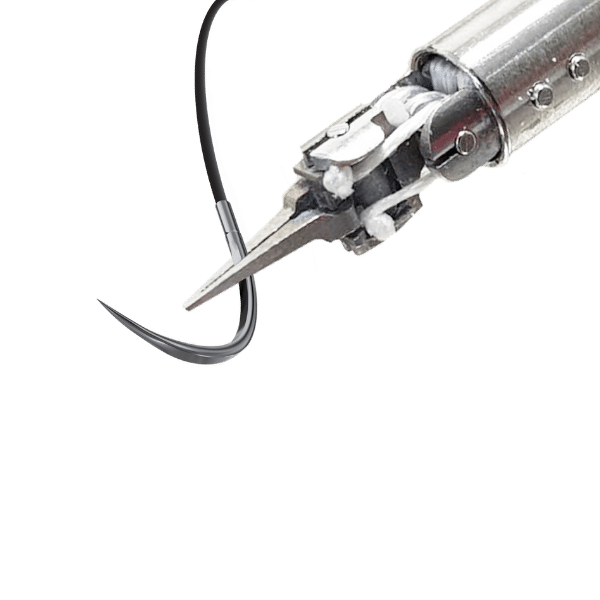
Designed for use with the Symani system, the suture features a shorter length and modified needle curvature to support precision in microsurgical and supermicrosurgical cases.
MMI (Medical Microinstruments Inc) announced the commercial launch of its Robotic Suture in the US. The product is designed for the Symani Surgical System— which supports microsurgical breast reconstruction and lymphatic repair to restore form and prevent or treat post-surgery lymphedema—and is intended for use in cases where delicate suturing is required.
Developed in partnership with Kono Seisakusho Co, the suture features a shorter length and needle enhancements tailored to robotic techniques. It is designed to improve handling and provide consistent performance during robotic anastomosis.
“The introduction of advanced technology, such as robotics, is driving continued demand for innovation in microsurgery,” says Mark Toland, CEO of MMI, in a release. “The suture expands that ecosystem with a solution that further supports surgeons and their patients with enhanced precision, efficiency, and outcomes.”
Features of the Robotic Suture
The suture length is approximately one-third to one-half the length of conventional micro sutures. This design is intended to improve manageability and decrease the time required for complex procedures. The system offers two needle curvatures to ensure optimal angulation for specific anatomy, which may improve patency and minimize tissue trauma.
The product range covers sizes from 8-0 to 12-0 to support both microsurgical and supermicrosurgical applications. It also allows for direct surgeon loading, which streamlines workflow by allowing for easier grasping during procedures.
“Our role has always been to advance surgery by solving needs at the smallest scale,” says Junichi Kono, president of Kono Seisakusho Co, in a release. “…Together with MMI, we have applied that same philosophy to robotic microsurgery, creating a suture solution that supports greater precision, control, and consistency in demanding procedures.”
Clinical Application and Market Impact
Siba Haykal, MD, PhD, section chief of reconstructive oncology and plastic, reconstructive, and microvascular surgeon at Yale New Haven Hospital, performed the first clinical cases using the new suture earlier this week.
“Standard suture needles often have a long curve not ideal for robotic work,” says Haykal in a release. “Based upon my early experience in supermicrosurgical procedures, the Robotic Suture has better positioning with a curvature that suits the instrument design, making needle passage easier with limited wrist articulation required.”
Haykal also notes that the shorter length is beneficial for robotic systems and smaller vessels, and these features could help reduce overall suture usage.
The global market for micro sutures sized 8-0 and smaller is estimated at $446 million. MMI indicates that reconstructive plastic surgery is a primary driver of growth in this market. The company plans to expand the availability of the robotic microsurgical suture into additional markets in the future.
Photo caption: MMI Robotic Suture
Photo credit: MMI