The new instrument adds cutting and coagulation capabilities to the robotic microsurgery system, with initial clinical use in lymphedema and head and neck surgery.
Medical Microinstruments Inc (MMI) has launched NanoWrist Monopolar Scissors in Europe. The instrument adds energy capabilities to the company’s Symani Surgical System, and the company announced the first clinical uses in lymphatic surgery and head and neck cancer surgery.
According to MMI, NanoWrist Monopolar Scissors are the first and only fully articulated robotic electrosurgical instrument for open microsurgery. The instrument is designed for use across a broad range of Symani applications. It allows surgeons to robotically perform sharp and blunt dissection, as well as cutting and coagulation of soft tissues, with a single instrument.
“Adding energy to Symani not only puts more power in surgeons’ hands but changes the way to think about energy instruments in microsurgery,” says Mark Toland, CEO of MMI, in a release. “These clinical cases are just the beginning of a broader energy portfolio designed to expand what surgeons can do for patients with complex conditions.”
First Clinical Cases in Europe
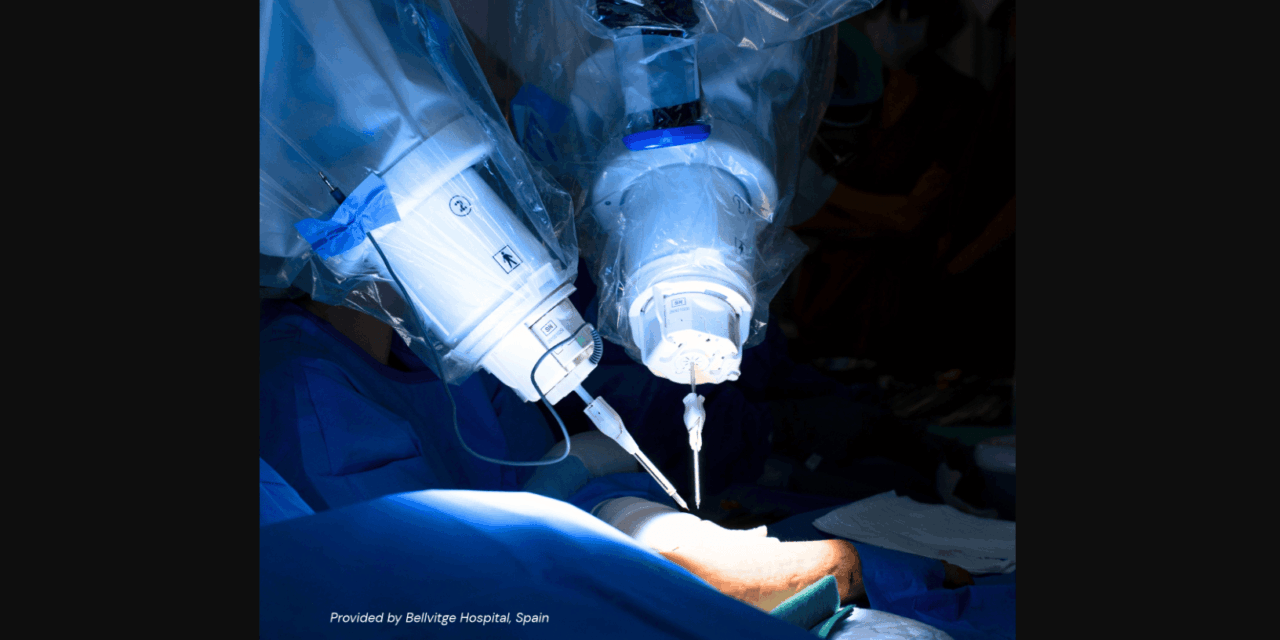
At Bellvitge Hospital in Spain, Sergi Barrantes, MD, a plastic reconstructive microsurgeon and head of the lymphedema surgery unit, used the instrument in a procedure involving two lymphovenous bypasses in a breast cancer patient with upper limb lymphedema. The Symani system was used for tissue dissection, bleeding control, and completion of the anastomoses, or vessel connections.
“Until now, part of the LVB procedure had to be performed manually. With this new tool, we can perform the entire microsurgical phase with the robot with a level of precision that is essential for these cases,” says Barrantes, in a release.
At RWTH Aachen University in Germany, the scissors were used to resect cancerous tissue in the head and neck region of a patient. The procedure was performed by Dr Ashkan Rashad, senior managing physician in the university’s Department of Oral and Maxillofacial Surgery.
“For patients facing cancer and its complications, surgery is about more than treating disease. It is about preserving function and restoring quality of life, something especially important when navigating the head and neck region,” says Rashad in a release. “Extending robotic precision to more of the procedure supports those goals by giving us greater control when working on such complex anatomy.”
Availability and Regulatory Status
The launch builds on MMI’s introduction of NanoWrist dissection instruments in 2025. The scissors received CE Mark in October 2026 and are available to hospitals across Europe.
In the US, the instrument has not been cleared by the FDA. A 510(k) submission is pending, and the company says safety and effectiveness have not been established in the US, where the device is not available for sale or use. MMI says it is working to expand regulatory approvals in global markets, including the US, but future availability cannot be guaranteed.
The Symani system combines wristed microinstruments with tremor-reducing and motion-scaling technologies. It is authorized for use in the US by the FDA and is CE marked in Europe, where it is used for microvascular, lymphatic, and peripheral nerve repair.
Photo caption: NanoWrist Monopolar Scissors
Photo credit: Medical Microinstruments Inc